 Today the H.E. Dr. Ali Sindi the Minister of Planning, along with H.E. Dr. Taher Abdullah Hawramy the Minister of Health and H.E. Safeen Mohsin Dizayee the Minister of Education announced recommendations from four studies conducted by the RAND Corporation over the past year in the KRG. The meeting was held at the Convention Center and over 70 Director Generals, senior advisors and other critical personnel attended. The RAND delegation was led by Michael Rich, Executive Vice President, and Robin Meili, Director of International Programs, and included the leaders of each project.
The four studies are:
· Increasing access to quality education for grades 1-9
· Developing strategies to improve primary health care
· Designing a system for collecting policy-relevant data
· Developing strategies to increase private sector development and reform of the civil service
The education study noted the high quality of the KRG’s primary school curriculum and recommended building up to 200 new 18 room schools per year for the next 10 years to accommodate as many as 110,000 new students each year. This would require hiring and training as many as 7000 new teachers every year along with modifying the evaluation and reward process for teachers and students.
In health care the study modeled the projected utilization of health care over the next 10 years and the implications for facilities, workforce and the potential for health insurance. Primary care is the cornerstone of the health care system. RAND recommended that the KRG standardize the services offered within each type of primary health facility, the number and training of doctors and nurses to attend to people in the facility and the care records and data that are kept on each patient.
For data systems, RAND interviewed every ministry to assess their policy priorities in support of the development of a diversified economy that is focused on improving the standard of living in the KRG. They identified over 650 data items that the KRG should collect to aid in its policy making, but divided them into three tiers: critical indicators most essential for high level officials – the Prime Minister and Council of Ministers, priority indicators that are useful to officials in each of the priority policy areas, and other indicators that should be collected when statistical systems are strengthened. RAND recommended that while each ministry should own its own data, that there should be centralized and open access to data for policy makers.
Given the growth in the population, the RAND team noted that over the next 20 years an average of 40,000 to 50,000 new jobs will need to be created every year. There are three promising strategies for doing this: improving the regulatory environment that will encourage the development of both domestic entrepreneurship and foreign direct investment, and encouraging the privatization of some current government functions while developing and implementing a performance appraisal and advancement system for civil service employees.
RAND has been asked to assist the KRG in the implementation of these reforms and their work will continue in the upcoming year. The RAND Corporation is a nonprofit institution that helps improve policy and decisionmaking through research and analysis. It has offices in the United States, Europe, and the Middle East.


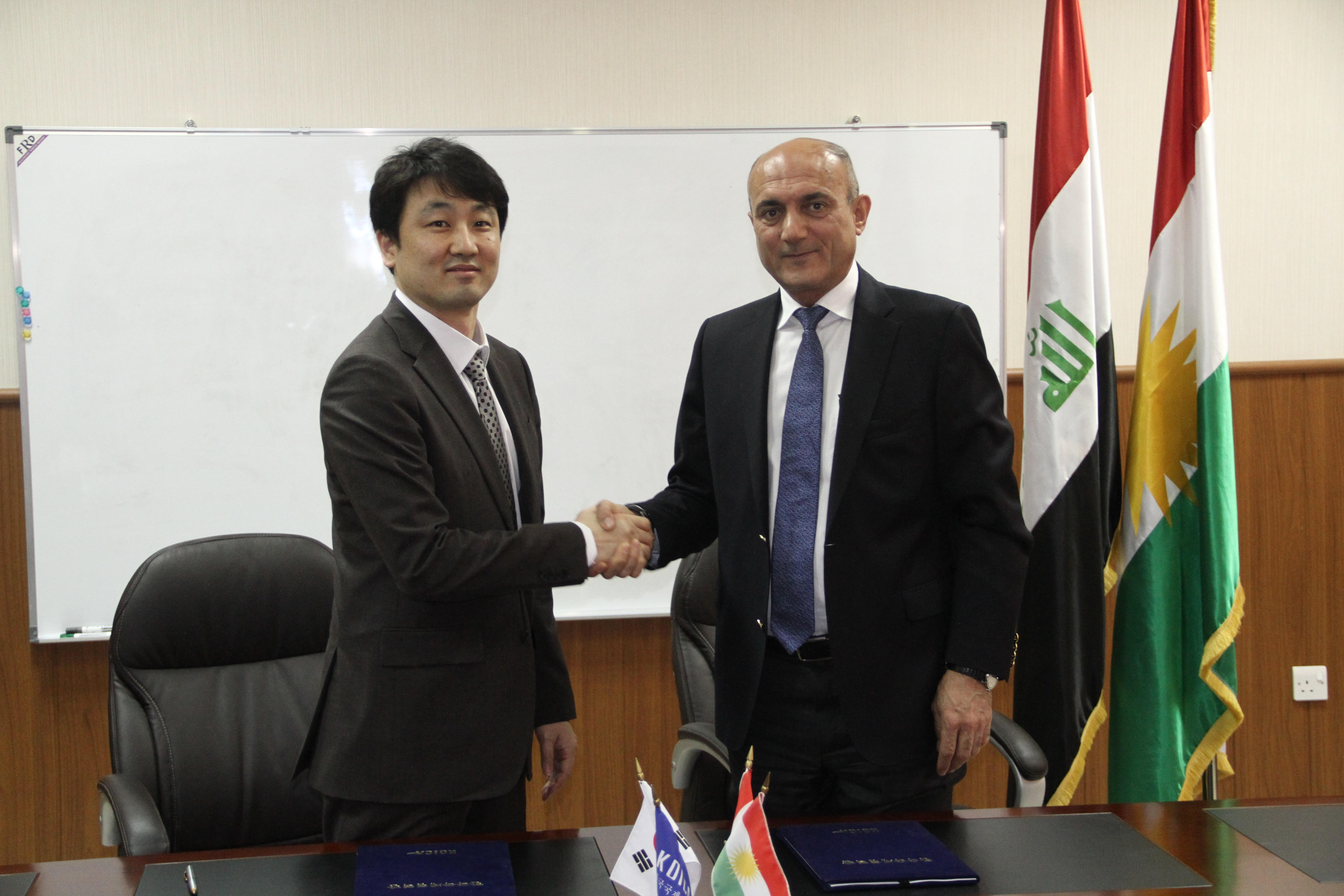 The Country Director of Korea International Cooperation Agency (KOICA) in Iraq, Mr. Ra Kapchae, has ...
 Erbil, 6 September 2012 – H.E. Dr. Ali Sindi recently wrapped up a three day trip to the Econ ...
 Erbil, 10 September 2012 – H.E. Dr. Ali Sindi attended the Second Annual United Nations Iraq R ...